| |
- Chemical name: 1-(2-chloro-4-pyridyl)-3-phenylurea
- Synonymous: N-(2-chloro-4-pyridinyl)-N'-phenylurea; KT-30; CN-11-3183;
4PU-30; CPPU; Phenyl-N'-(2-chloro-4-pyridyl)urea
- Structural Formula: 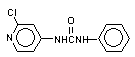
- Molecular Formula:.......................... C13H10N3OCl
- CAS No: [68157-60-8]
- Toxicology: Acute oral LD50:male rats 2787 mg/kg, female rats 1568 mg/kg
Male mice2218 mg/kg,female mice 2783 mg/kg Acute dermal LD50 for rabbits
> 2000 mg/kg Slightly irritating to skin, and irritating to eyes. Inhalation
LD50 (4h) for rats: no mortality in saturated atmosphere. NOEL 7.5mg/kg
b.w. daily.
- M.W. .................................................247.68
- Appearance:........................... White crystal powder.
- Assay:................................................. 98%min(HPCl)
-- 99%min(HPCl)
- Melting Point..........................................................171-172
°C
- Ignition Residue.........................0.2%max.
- Loss on Drying........................................0.1% -- 0.5%
Application:
- Forchlorfenuron(KT-30) is as a plant growth regulator widely used in
griculture horticul ture and fruitsto increase fruit size of fruits,e.g.kiwi
fruit and table grapes,to promote cell division, to improve the quality
of fruits and to increase yields.Crop Time applied Concentration Method
applied Effects Peach 30 days after 20ppm Sprey on fruit Increases fruit
size, Fruit blossom Improves color and qualityGrape 14-18 d prior 1-5ppm
plus Soak fruit Improves efficacy of GA Full blossom 100ppm GA3 Apples
Growth stage 50ppm Spray on buds Promotes branch budding Potato 70 d after
planting 100ppm Spray on plant Increases yield Kiwi fruit 20-30 d after
blossom 5-10ppm Soakfruit Increases fruit size.
|
|
